The Avengers began in Marvel comics as a team assembled from heroes who already had stories of their own. That structure became the source of the group’s appeal: strength did not remove disagreement, and saving the world required characters with competing methods to cooperate. Film later turned the name into a global blockbuster reference, but decades of comics, animation, games and changing line-ups sit behind it. This Avengers men’s T-shirt uses the team name without copying Marvel logos, costumes or screen artwork.
The team forms in comics
Stan Lee and Jack Kirby introduced the Avengers in 1963. Iron Man, Thor, Hulk, Ant-Man and the Wasp answered a threat involving Loki, then chose to remain together. Captain America joined soon afterwards when the team found him frozen and revived him. The early premise allowed Marvel to combine characters from different titles while making their personalities collide.
The roster changed rapidly. That flexibility became fundamental. Hawkeye, Quicksilver and Scarlet Witch joined despite complicated pasts, while Black Panther, Vision, Black Widow and many others expanded what the team could be. Membership often offered characters a second chance or a new context outside their solo adventures.
“Earth’s Mightiest Heroes”
The familiar description captures scale but not certainty. Avengers stories work when power alone is insufficient. Ultron is frightening partly because he emerges from heroic ambition and technological overreach. The Kree-Skrull War expands conflict into space, while Civil War turns disagreement about responsibility and authority inward.
Different eras place emphasis on different leaders and moral questions. Captain America often represents collective duty, Iron Man calculation and invention, Thor mythic power, and the Wasp a foundational intelligence too easily overlooked in simplified retellings. No single member permanently owns the team.
Building the Marvel Cinematic Universe
Marvel Studios introduced individual heroes before bringing them together in 2012’s The Avengers, directed by Joss Whedon. Nick Fury’s initiative linked Iron Man, Captain America, Thor, Hulk, Black Widow and Hawkeye against Loki and the Chitauri in New York. The film proved that several established franchises could share one coherent event.
Later films expanded the scale. Age of Ultron introduced Vision and developed conflict over artificial intelligence. Infinity War and Endgame brought a much larger collection of characters into the fight against Thanos. Endgame’s time-travel structure turned earlier films into shared memory and gave the original line-up emotional closure.
Why the group mattered to audiences
The Avengers model shaped modern blockbuster production, sometimes for better and sometimes at the expense of smaller self-contained stories. Its strongest moments are not simply crowded battles. They are conversations in which people with incompatible histories decide whether they can trust one another.
Young viewers may arrive through animation or games, comic readers may favour a particular line-up, and cinema audiences may hear the name as shorthand for the MCU. That multiplicity is the advantage of using “Avengers” alone. It leaves space for several generations of fandom.
An independent name treatment
The official stylised “A” and character insignia belong to Marvel. Players Couture therefore relies on plain typography and does not present the shirt as licensed merchandise. The result is a knowing reference for people who associate the team with assembly, argument and collective action, rather than a reproduction of a poster or superhero costume.
Team stories allow renewal
A solo hero can become trapped by a fixed supporting cast, while an Avengers line-up can change whenever the story demands a new balance. Writers use that flexibility to pair established icons with less familiar characters, move former villains into heroic roles and test leadership under different pressures. Readers often remember a particular roster as “their” Avengers even when later teams look completely different.
The same openness explains why the name survives adaptation. Animation can simplify the team for younger viewers, games can make every power playable, and film can use the group as a meeting point for separate narratives. The core idea remains assembly rather than one permanent membership list.
Conflict inside the alliance
The team is most interesting when unity has to be earned. Members disagree about authority, acceptable risk and whether power creates a duty to intervene. Those arguments prevent the group from becoming a simple collection of abilities. A successful Avengers story lets each perspective change the plan, then makes cooperation feel like a decision rather than a slogan.
Choosing the shirt
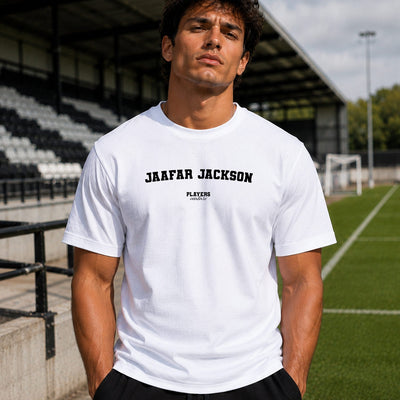
This is a men’s crew-neck T-shirt in soft ringspun cotton with a regular fit. The name-led layout is intended as understated everyday fanwear, not a replica shirt or a copy of protected artwork. It works with denim, chinos, shorts or joggers, and layers easily beneath an open overshirt, bomber or casual coat.
Sizes are S, M, L, XL, 2XL and 3XL. Available colours are White, Navy, Red, Black and Gray. White gives the lettering its cleanest background, Navy and Black are quieter choices, Gray is an adaptable neutral, and Red is the strongest statement. Compare the measurements with a shirt that already fits well. Choose the next size when a deliberately loose silhouette is preferred.
Made to order in the United Kingdom
Players Couture prints the garment in the United Kingdom after purchase, with free UK delivery. Producing to order reduces the need to hold large quantities of finished pre-printed stock across every subject, size and colour. It does not make clothing production waste-free, and the description makes no such claim.
Wash inside out on a cool cycle with similar colours. Avoid bleach, direct ironing over the print and high-heat tumble drying. Air drying is preferable where practical. For a gift, check the recipient’s usual size, preferred colour and whether they like a standard or roomier fit. This is independent fan-inspired apparel. It is not official merchandise and no endorsement by the person, club, studio, governing body, venue or organisation is implied.