
The Story of Maradona — Football's Flawed Genius
Diego Armando Maradona was football's great contradiction. In the space of four minutes on 22 June 1986, he committed the most notorious act of cheating in the history of the sport and scored what has been voted the greatest goal ever seen. The same player, the same match, four minutes apart. Only Maradona could have done both.
His life was a similar series of extremes — extraordinary triumph and extraordinary self-destruction, genius and chaos, adulation and scandal, poverty and excess. When he died on 25 November 2020, at the age of 60, Argentina declared three days of national mourning. Hundreds of thousands of people queued through the night to file past his coffin in Buenos Aires. The world understood it had lost something irreplaceable.
Villa Fiorito — Born Into the Slums
Diego Maradona was born on 30 October 1960 in Lanús, Buenos Aires province, the fifth of eight children. His family lived in Villa Fiorito, a shantytown on the outskirts of Buenos Aires — a place of dirt roads, corrugated iron roofing, and deep poverty. His father, Diego Senior — known as El Toro, the Bull — worked in a bone-meal factory. His mother, Dalma, held the family together.
He received his first football at the age of three from his cousin. By the time he was eight, he was performing juggling tricks at half-time for the youth team Los Cebollitas — the Little Onions — in front of thousands of people. A journalist who saw him perform wrote that he was going to become the greatest footballer in the world. Maradona was ten years old.
At sixteen, he made his professional debut for Argentinos Juniors. He was the youngest player to play in the Argentine Primera División at that point. Within two years, he was the best player in South America. Within four, the best in the world.
1982 — The World Cup That Broke His Heart
Maradona arrived at the 1982 World Cup in Spain as the most anticipated player in the tournament. Argentina were the defending champions. He was twenty-one and already regarded as the finest player on the planet. The expectations were enormous.
He was marked brutally throughout the tournament — fouled repeatedly, provoked constantly. In Argentina's final group match against Hungary, a match they were already winning comfortably, a Hungarian defender caught him with a vicious late tackle. In the final group match against Brazil, Maradona was sent off for a retaliatory kick on a Brazilian midfielder. Argentina were eliminated. The tournament was over.
He flew home humiliated. He would spend the next four years preparing himself for revenge.
Barcelona and Napoli — The Club Years
After the 1982 World Cup, Maradona signed for Barcelona for a then-world record fee of £5 million. His time at the Nou Camp was complicated — brilliant moments undermined by injury, hepatitis, and an increasingly difficult relationship with the club's hierarchy. He left for Napoli in 1984 for another world record fee, £6.9 million.
At Napoli, he found his spiritual home. The club had never won the Serie A title. In Maradona's first season, they finished third. In 1987, they won the Italian league for the first time in their history. In 1989, they won the UEFA Cup. In 1990, they won Serie A again. Naples — a city in the impoverished south of Italy, long regarded with condescension by the wealthy north — had a champion to call its own. The city worshipped him absolutely.
To understand the depth of that devotion, consider this: when Napoli played Juventus of Turin, Maradona was jeered by the Italian supporters. The Naples fans responded by displaying a banner that read: "Maradona — honorary Neapolitan."
Mexico 1986 — The Greatest Individual World Cup Performance
The 1986 World Cup in Mexico was Maradona's tournament. Argentina won it, and they did so almost entirely because of him. He scored five goals and made five more in seven matches. He was voted Player of the Tournament without serious argument. He was, across those three weeks, the greatest footballer who had ever played in a World Cup.
The quarter-final against England on 22 June 1986 contains, in its 90 minutes, the entire Maradona story — the genius and the cynicism, the sublime and the scandalous, inseparable from each other.
In the 51st minute, Maradona and the England goalkeeper Steve Hodge both challenged for a cross. Maradona punched the ball into the net with his left hand. The referee, positioned poorly, did not see it. The goal stood. Maradona's description afterwards — "a little with the head of Maradona and a little with the hand of God" — became one of the most famous phrases in sporting history.
Four minutes later, Maradona collected the ball in his own half, turned, and began a run that covered sixty metres, beat five England outfield players and goalkeeper Peter Shilton, and finished with the ball in the net. It took ten seconds. It has been voted, in multiple polls and by FIFA, the greatest goal in World Cup history. The Goal of the Century.
He scored again in the semi-final against Belgium. He set up both goals in the final against West Germany as Argentina came from behind to win 3-2. The trophy was his.
1990 — The Defence and the Penalties
Argentina returned to defend their title in Italy in 1990. Maradona was thirty, heavier, slower, troubled by injury and by the lifestyle that was beginning to take its toll. Argentina were not the same side. But they reached the final again — thanks largely to two penalty shoot-out victories, including one against the hosts Italy in the semi-final in Naples, where Maradona was greeted with a roar of support from the local fans.
They lost the final to West Germany, 1-0, in one of the least memorable finals in World Cup history. Maradona cried on the pitch at the final whistle — not the tears of a seventeen-year-old boy overcome by triumph, as in 1958, but the tears of a man who knew his time had passed.
The Fall
After 1990, the story becomes difficult. A failed drugs test for cocaine in 1991 led to a fifteen-month ban. A positive test for ephedrine at the 1994 World Cup ended his international career abruptly, mid-tournament. His weight fluctuated dramatically. He was hospitalised multiple times. He required heart surgery. His battles with addiction were public, painful, and prolonged.
And yet he survived all of it. He returned to management, coaching Argentina, Napoli's youth teams, and several other clubs with varying degrees of success. He remained, throughout all of it, the most famous person in Argentina and one of the most famous on earth.
The Legacy
Maradona died on 25 November 2020, two weeks after brain surgery for a blood clot. He was sixty years old. Argentina declared three days of national mourning. The images of hundreds of thousands of people queuing through the night to pay their respects in Buenos Aires told their own story.
He was, in the end, what football produces very rarely — a player so gifted that the normal rules did not seem to apply, playing for a sport and a country that needed him to be exactly that. The contradictions were inseparable from the genius. The Hand of God and the Goal of the Century were four minutes apart because they could only have come from the same person.
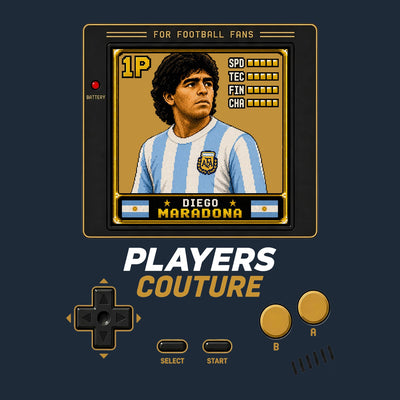
Shop the Maradona 10 Shirt Frame Hoodie and the Maradona Dribble Patch Hoodie, or browse the full Argentina collection at Players Couture.







0 comments