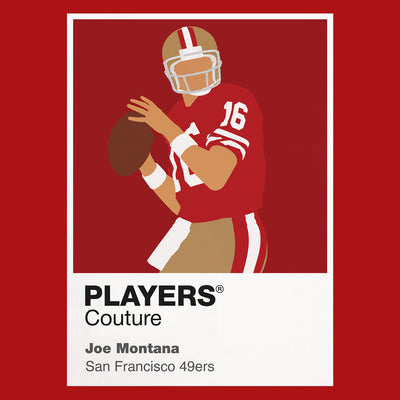
Sammy Baugh Washington Redskins Men’s T-Shirt – Slingin’ Sammy Fan Clothing
Represent one of the founding legends of professional American football with the Sammy Baugh Washington Redskins men’s T-shirt from Players Couture. Created for Washington supporters, historic football fanatics and admirers of remarkable all-round sporting talent, this distinctive piece of clothing celebrates the passing, punting and defensive excellence that made “Slingin’ Sammy” Baugh a hero across several generations.
The colourful, poster-style player graphic is positioned as a compact badge on the left chest, measuring approximately 10 cm high. Its considered placement creates a clean, modern appearance while retaining a clear connection to a favourite Washington player. The T-shirt can be worn as everyday fan clothing as well as for games and special sporting occasions. Explore more legends in the American Football collection, or discover further Washington designs in the Washington Commanders collection.
From Texas to TCU
Samuel Adrian Baugh was born in Temple, Texas, in 1914 and grew up in the town of Sweetwater. Baseball was initially his preferred sport, and he developed into a talented third baseman. His route towards becoming one of American football’s most influential quarterbacks began when he attended Texas Christian University.
TCU coach Dutch Meyer recognised Baugh’s exceptional throwing ability and helped him develop as a passer. At a time when many teams used the forward pass sparingly, Baugh demonstrated that an accurate and imaginative passing attack could become the central element of an offence.
Across three varsity seasons from 1934 through 1936, Baugh attempted 587 passes and threw 39 touchdowns. Those totals were extraordinary during an era when attempting ten passes in a game could be considered adventurous. TCU lost only seven of 38 games during his time with the team.
Baugh helped the Horned Frogs complete an outstanding 1935 campaign and defeat LSU 3–2 in the Sugar Bowl. He later led TCU past Marquette in the inaugural Cotton Bowl following the 1936 season. His performances earned All-American recognition and eventually resulted in induction into the College Football Hall of Fame.
Washington’s New Star
Washington selected Baugh with the sixth overall pick in the 1937 draft. The franchise moved from Boston to Washington that year, making his arrival part of a significant new beginning. Baugh immediately demonstrated that the forward pass could be used as a consistent attacking weapon rather than an occasional surprise.
During his rookie season, Baugh led Washington to the championship game against the Chicago Bears. He completed 17 of 33 passes for 335 yards and three touchdowns as Washington won 28–21. His passing-yard total was remarkable for the period and remained a championship-game rookie record for decades.
Baugh had delivered a title in his first professional season. His arm strength and accuracy made him an immediate attraction, while his relaxed Texas personality helped establish “Slingin’ Sammy” as one of the most recognisable players of the era.
Transforming the Passing Game
Baugh began his professional career as a single-wing tailback, a position that required him to run, pass and handle other responsibilities. He later moved into the T-formation quarterback role as offensive systems evolved.
He could throw accurately over short, medium and long distances, leading receivers into space rather than simply sending the ball towards an area. His performances helped demonstrate that passing could be efficient, controlled and central to winning football.
Baugh led the league in passing six times, a record-setting achievement. He finished first in completion percentage on eight occasions and repeatedly led major categories such as passing yards, touchdowns and efficiency. His ability to limit interceptions was also exceptional for an era in which turnovers were common.
The 1945 season produced one of his most efficient statistical performances. Baugh completed 70.3 per cent of his passes and recorded a passer rating of 109.7, figures that were decades ahead of the standards generally associated with his period.
More Than a Quarterback
Baugh’s greatness cannot be understood through passing statistics alone. Players of his generation regularly appeared in several phases of the game, and Baugh was exceptional as a defensive back and punter as well as a quarterback.
He led the league in punting for four consecutive seasons from 1940 through 1943. His 1940 average of 51.4 yards per punt remains one of the most remarkable records in American football. Across his career, he averaged 45.1 yards from 338 punts.
As a defensive back, Baugh intercepted 31 passes. In a 1943 game against Detroit, he collected four interceptions, matching a single-game record. His ability to read opposing quarterbacks reflected the same awareness that made him so effective on offence.
The 1943 season provided the clearest demonstration of his all-round brilliance. Baugh led the league in passing, punting average and defensive interceptions. It is difficult to imagine a modern player finishing as the leading performer in three such different areas during the same campaign.
Championship Rivalry with Chicago
Washington and Chicago developed one of the defining rivalries of the era. After Baugh inspired the 1937 championship victory, the teams met again in the 1940 final. The Bears produced a devastating performance and won 73–0, a result that remains the largest margin in a championship game.
Baugh and Washington responded by continuing to compete at the highest level. During the 1942 season, Washington completed a 10–1 regular-season record and earned another championship meeting with Chicago.
This time, Washington’s defence limited the Bears while Baugh directed the offence. Washington won 14–6, securing the second championship of his career and reversing the disappointment of the earlier defeat.
Baugh led Washington into further championship games in 1943 and 1945. Although both ended in defeat, his five appearances on the championship stage demonstrated the consistency he brought to the franchise.
Later Career and Lasting Records
One of Baugh’s finest passing seasons came in 1947, when he produced 2,938 yards and 25 touchdowns across only 12 games. On a day arranged by Washington supporters to celebrate him, Baugh responded by throwing six touchdown passes in a 45–21 victory over the Chicago Cardinals.
He remained with Washington throughout his entire 16-season professional career, retiring after the 1952 campaign. Baugh completed 1,693 passes for 21,886 yards and 187 touchdowns. Those figures look modest beside modern 17-game statistics, but they were achieved during a very different era with shorter seasons and less protection for quarterbacks.
Baugh earned seven First-Team All-NFL selections and was chosen for the All-Decade Team of the 1940s. He was also selected for major anniversary teams recognising the greatest players in the sport’s history.
In 1963, Baugh became one of the 17 charter members inducted into the Pro Football Hall of Fame. Washington retired his number 33, ensuring that his connection with the franchise remained permanently recognised. He died in 2008 at the age of 94.
International Context
American football did not provide players of Baugh’s era with a regular senior national-team career or an established international tournament. He therefore did not represent the United States in a World Cup-style sporting competition.
His influence eventually reached far beyond America because the passing game he helped popularise became central to the sport’s international appeal. Modern fans in the UK and Europe watch a version of American football shaped by pioneering quarterbacks such as Baugh, who demonstrated the possibilities of an accurate forward pass.
How to Wear Your Sammy Baugh T-Shirt
This men’s T-shirt is made for Washington supporters, number 33 collectors, vintage sports enthusiasts and American football fanatics who appreciate the history of the game. Wear it for Sunday fixtures, classic-game screenings, late-night UK broadcasts, stadium visits or relaxed occasions with friends and family.
Pair it with jeans and trainers for an easy everyday outfit, or combine it with cargo trousers, shorts or joggers. During cooler UK weather, layer it underneath a zip hoodie, overshirt or jacket. The compact left-chest badge provides a distinctive historical reference without overwhelming the rest of the outfit.
The Sammy Baugh T-shirt is available in White, Black, Red, Navy and Grey, with adult sizes ranging from S to 3XL. Black and Navy create versatile darker foundations for the colourful artwork, while White and Grey offer lighter alternatives. Red provides a bolder choice for supporters who want the graphic to stand out.
Made to Order by Players Couture
No completed T-shirt stock is produced before an order is placed. Each Sammy Baugh garment is prepared on a made-to-order basis for the individual fan who selects it. This approach helps Players Couture reduce unnecessary overproduction while offering supporters a distinctive alternative to predictable sports merchandise.
An Independent Sammy Baugh Fan Tribute
This Players Couture design is an independently created tribute inspired by admiration for Sammy Baugh and his sporting achievements. It is not intended to mislead customers, imply an unauthorised commercial relationship or infringe upon the rights of any player, team, estate or organisation. The artwork is presented in good faith within the spirit of fan expression and fair usage.
If a relevant rights holder does not share the positive intentions behind the design and raises a concern, Players Couture is willing to review the matter and remove the product where appropriate. The brand also hopes to collaborate with player representatives or estates in the future, providing an agreed royalty or directing a share of sales towards suitable charitable causes.
For a friend, family member or devoted Washington fan, this T-shirt is a unique way to represent number 33 and celebrate the extraordinary three-way player who passed, punted and defended his way into American football history.